CASE STUDY — 03
Global Cigar Express
Demo, password-protected
A premium cigar store on Shopify, with buyers in Asia as its first market.
- Shopify
- UX / CRO
- Liquid + Tailwind
- Figma
- ROLE
- UX/CRO strategy · Design · Shopify development
- YEAR
- 2026
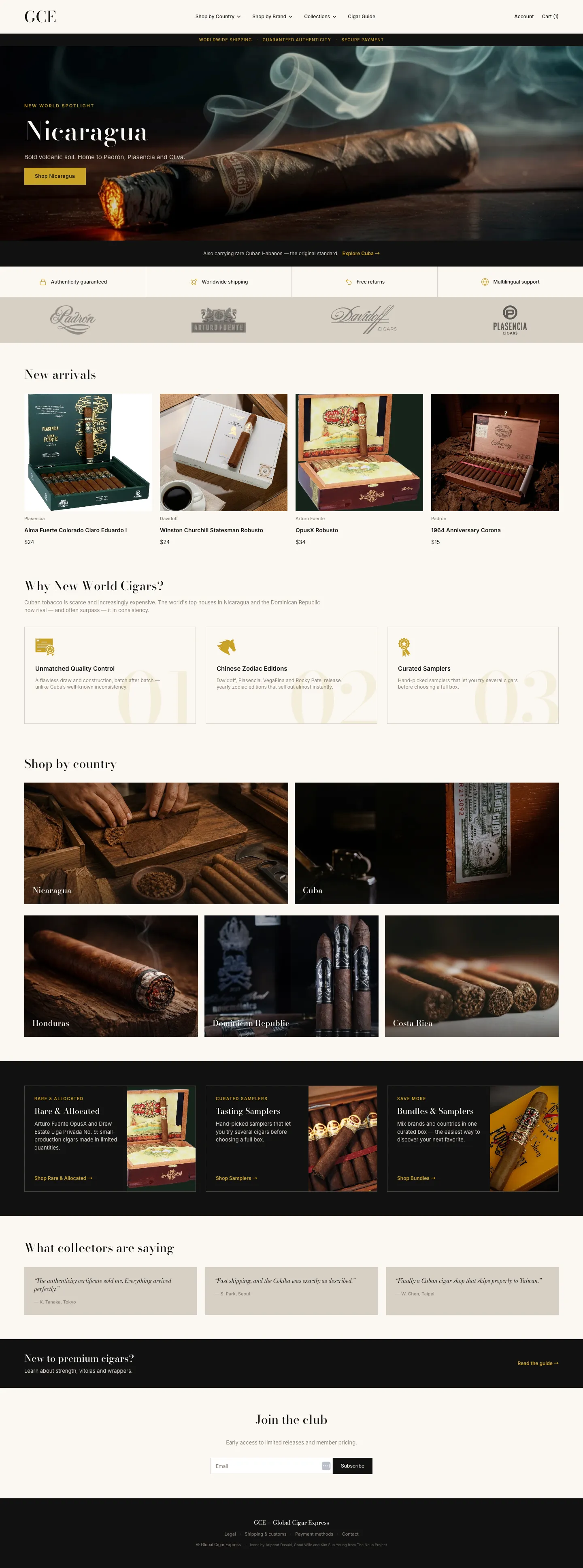
Demo environment. Testimonials are placeholder content.
The problem
The client’s store ran on WordPress and depended on external plugins for core e-commerce features. They wanted a more robust store without that dependency, one that could also work as a marketing and sales tool: a functional demo to present the business model to potential buyers and investors. The first target market is Asia (China, Taiwan and Korea), with the rest of the world to follow. The catalog centers on New World cigars from Nicaragua, the Dominican Republic, Honduras and Costa Rica, with Cuba as an aspirational category.
My role
I led UX and CRO strategy, designed the experience in Figma, built the Shopify theme, structured the content and documented the business reasoning behind each decision. Logo and brand identity were outside my scope.
Process
I started by analyzing a reference store specializing in Cuban cigars and mapping a sitemap. I used the reference to understand the category, not to copy it: it serves a different market with a different model. From wireframes, I explored three visual directions (Heritage Havana, Modern Onyx and Warm Boutique) and chose Modern Onyx: onyx black, warm white and brass gold, with Bodoni Moda for headlines and Inter for text, a restrained, premium feel where the product does the talking. I designed high-fidelity desktop and mobile screens for the homepage, category, product page, cart and checkout. Some concepts stayed as explorations, such as a hero with floating navigation and a scroll-driven “Shop by country” story. I then built the theme in Shopify and refined it through my own testing.
Key decisions
Browse by origin, not by discount. Navigation is organized by country, brand and vitola. A premium buyer looks for origin first.
Nicaragua leads, Cuba supports. The homepage puts Nicaragua at the center and Cuba in a secondary band. The “Shop by country” grid uses a 2 + 3 layout with Nicaragua and Cuba larger and on top, because attention concentrates at the top and left of a page (Nielsen Norman Group’s eye-tracking research), and what is seen first gets chosen more.
Built for Asia from the type system up. Bodoni Moda and Inter don’t cover Chinese or Korean, so the type stack includes fallback fonts for both. Shopify was also chosen because it supports multiple languages natively, so translations can be added without rebuilding the store.
Shopify with Liquid and Tailwind, not headless. Fewer moving parts, a native checkout and accounts, and a theme the client can edit and maintain from the theme editor.
Product data the store can grow with. Cigar attributes (vitola, size, strength, wrapper) live in metafields and hide when empty. Country collections build automatically from tags, so adding a product doesn’t require touching code. Filters only appear when they have at least two different values, so buyers never see a filter that does nothing.
A product page for a considered purchase. A two-column gallery with zoom, a quick line of key data (strength, vitola, size), full specifications, single or box options, and a sticky purchase column on desktop. The cart opens as a side panel on desktop and full screen on mobile.
Trust through honest content. Tobacco is a regulated, high-trust category. The store includes age verification and styled policy pages, and I removed claims without support: “95+ points” came out, and “guarantees authenticity” became “helps verify authenticity”.
Honest result
GCE works as a complete, navigable store in a password-protected demo environment: a homepage, a category page with the real catalog of 21 products, product pages, a side cart, age verification, styled policies, and the brand applied to checkout and customer accounts. It has not launched and has no real buyers; testimonials and prices are sample content. One known limitation: sorting applies only to the products already loaded on the page. What it demonstrates is strategy, design and theme development working together in a regulated category.
What’s pending
These are next steps on the client’s side, not part of this scope:
- A payment processor that accepts tobacco (Shopify Payments doesn’t).
- Legal review, plus minimum-age and returns policies.
- Translations for the first market (Chinese and Korean), local currency, shipping and payments.
- Professional product photography.
- Domain and Shopify plan.
What I learned
Regulated categories surface dependencies early. For tobacco, payments and legal review belong at the start of planning, not the end.
A reference is for understanding, not copying. Deciding not to copy forced me to state why GCE needed a different structure.
A handoff README is part of the product. Someone else should be able to pick up the theme without me.
Case study for portfolio purposes. Brand names, logos and images belong to their respective owners.